Tuesday, May 29, 2012

Wellfleet Memorial Day

This memorial Day weekend was the third in a row spent at one of the most magical locations I know, The Elephant House on Mayo Beach, Wellfleet, Massachusetts. It's a huge place, built by the son of Lorenzo Dow Baker - a pioneering banana importer (his company is now Chiquita), and a pioneer of the Wellfleet tourist industry (he built a massive hotel on a Wellfleet's Commercial Wharf called the Chequessett Inn that was demolished by wind-driven ice in the 1930s). The house is on the left:


The views of Great Island, Mayo Beach, Lieutenant Island and Wellfleet Harbor are spectacular. And The four cottages of Edward Hopper's famous watercolor "Cottages at Wellfleet" are just three houses down the beach (on the right above). These days, they are more traditional Cape Cod colors - weathered grey shingle and white.


I had a generous opportunity to paint many 6 x 10 plein air sketches.
Great Island in the Fog

Great Island at Half Tide

Great Island Sunset

Lieutenant Island in the Fog

Mayo Beach Marsh

Mayo Beach Sunset

Mayo Beach Fog


 I also got a chance to try my hand at three larger plein air paintings. These are about 16" x 22".

Great Island, Wellfleet

Hopper's Cottages, Mayo Beach

Mayo Beach and Great Island
 
Somehow I knew the Hopper cottages were going to defeat me. But the weekend also included a pilgrimage up to South Truro seeking Hopper's cottage studio building, still visible from the beach. Took me a while - and a long walk south along Ryder Beach - to find it. But his small cottage with a massive north-facing window is easy to spot amongst the properties approaching McMansion size.


Good times, productive painting, good cheer, and mighty fine seafood with very good friends and their wonderfully creative kids made for one heck of a weekend. Twelve dozen raw oysters, five dozen clams for linguine, a massive amount of grilled swordfish and a goodly portion of smoked bluefish made for a heckuva lot of seafood feasting in just three days!


Saturday, May 19, 2012

Pondside Plein Air


My larger paintings seem to be suffering from something like me tightening up when faced with a vast white "high risk"space. I thought the remedy might be some cheap paper and some speed painting down by the pond:


Thursday, May 17, 2012

Let's Go Make a Picture on the Island of Stromboli

When Woody Guthrie died, he left behind several notebooks of song lyrics that hadn't yet become songs. His daughter and estate made an arrangement with singer-songwriter Billy Bragg and the band Wilco (two of my favorites) to see if they could make anything of them. This resulted in the outstanding Mermaid Avenue albums.

One of the simplest and affecting little love songs I've ever heard is from this project: "Ingrid Bergman" featuring Billy Bragg's plaintive vocal and a simple finger-picked acoustic guitar. Guthrie's ode to Bergman's sad and sly beauty seems to have been written around 1950 when she was off making "Stromboli" - a film set on a volcanic island between Sicily and Italy. Perhaps he just liked the sound of the word and used it throughout.

I was listening again recently, and when the lyric says "... let's go make a picture. On the island of Stromboli..." I got to wondering what Stromboli actually looks like, and, well whether I could make a picture of it.

I could. It looks like this:


This one is relatively large: a 15" x 22" half-sheet of Arches cotton rag. That door started with a healthy layer of M. Graham's Napthol Red - a wonderfully pigment-rich watercolor that uses a touch of honey in it's binding medium along with gum arabic. Makes for a soft, moist color. All of which seems to suite Bergman. Here I've added some Permanent Rose and Ultramarine Blue to recreate the effect of a sunbleached wooden door whose red paint is beginning to fade where it's thinner. The shadows were a real challenge here too. I'll bet there is a wonderful coutyard behind that door.

It's temping to call this painting Ingrid Bergman...

Friday, May 4, 2012

First half-sheet

I've been studying John Singer Sargent's watercolors closely looking for insights on the play of light and shadow.


He loved the spontaneity of the medium and how it offered a release and escape from what was (sometimes) the drudgery of commissioned portraits. He often worked with a somewhat limited palette and almost always employed very loose and free brushwork. Here is what I came up with in about twenty minutes - it's an alley in Kairouan, Tunisia:


A few problems to be sure, but that's what sketches are for!

The next day, I went to the New England Watercolor Society's Biennial National Show. The work, some 70 paintings, was quite spectacular and inspiring. Daunting even, since it was easy to see how far I have to go to achieve anything like that level of proficiency. The other thing that jumped out at me was that only two or three of the paintings were anywhere near as small as I've been working.

The next day I rigged up a thick sheet of waterproof gatorfoam to a piece of scrap wood with velcro and attached it to my camera tripod with a T-nut countersunk into the wood:


Then I carefully tore a full sheet of Arches paper in half, wet it down, and stapled it to the gatorfoam to dry and stretch. The next day I went to work:


Right off the bat I ruined the sky with a hasty wash of ultramarine. I also learned that I had scratched through the paper's sizing either with my staple gun or my wedding ring - the scratches make the paper more absorbent, which leads to darker lines:


By the end of the day I was very frustrated by all the new challenges in motion at once. Working with four times the area meant that my favorite brushes didn't fill the space like they had on smaller paper. Working vertically caused all sorts of problems - I wasn't used to so much gravity working on the paint and water. My bifocals were bothering me. I never seemed to mix enough paint for the area I was tyring to cover. I couldn't find the balance between care and freedom in the brushwork... anyway, I stopped here at the end of the day:


The next day I wiped out the sky as best I could. Knowing I had a failed painting on my hands at that stage was oddly liberating. I continued to experiment with textures and details for a while and have stopped here for now:


I did straighten out that gully/ditch edge on the bottom after this photo, and on the following day I did what I could to darken the darks, add detail and contrast. I think I've gone about as far as I can go with this one.


Thursday, April 26, 2012

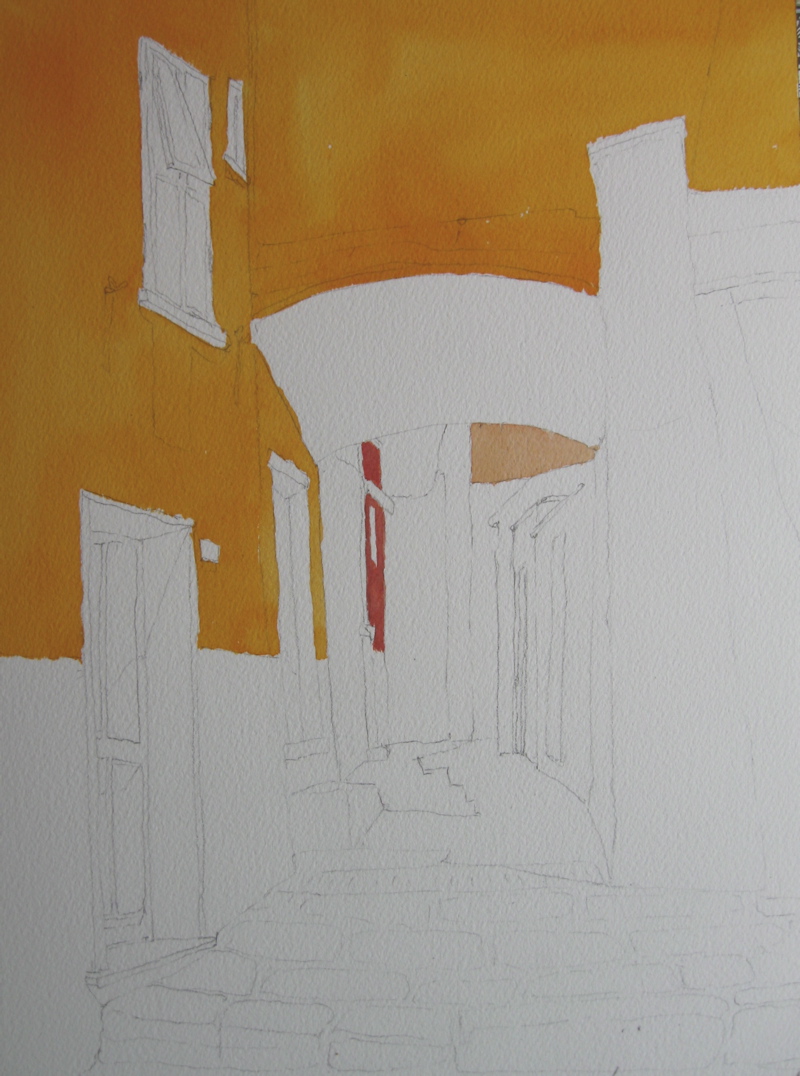
Evolution of a saffron alley

I've been wanting to get more comfortable with saturated color and better at dark shadows and this one was a nice challenge. I started with a value drawing, to sort of force myself to see the patterns of the darkest darks. I used a fabulous new pencil on this: a Cretacolor Monolith 8B. It's a solid, woodless pencil of Austrian graphite with a lacquer finish on the ouside (instead of wood). Soft & buttery...


Next, I mixed up a new tube of Winsor Orange PO62 with some Gamboge Yellow and just went for it (some of the overwhelming chroma was later toned down with a light wash of ultramarine)


I don't have any shots of the in between stages, but here's the scene at the kitchen table:

  Hard to see, but on the left is a quick wet-on-wet study painting I did of a rock to try some techniques of mixing ultramarine, raw sienna and burnt sienna. It has splashed clean water and splashed paint for texture, some dry on wet layers for detail... all sorts of interesting things that I mostly then proceeded to ignore when it came time to paint the column of rock/stones in my main painting! Here 'tis:


la Spezio, Italy

Wednesday, April 25, 2012

MGM's plein air kit

Here is the travel watercolor kit that belonged to my grandmother, Margaret Gardner Mitchell. It looks to be something she picked up on a trip to the UK, probably in the late 1970s or early 1980s. George Rowney and Company, of Bracknell, Berskshire is the manufacturer, and is/was one of the more famous of the UK watercolor outfitters. It was a family owned business from 1783 until 1983 - Turner was apparently a family friend. When the heirs ran dry, they were acquired by Daler, makers of artist's canvas boards and the company is now called Daler-Rowney.

Anyway, this one is tiny, with a built-in water flask and detachable lid that doubles as a water well. I'm pretty sure most of the paint wells are filled with the original paint (or what's left of it). The brush has a detachable handle so it will fit inside, there's a thumb-ring on the bottom to hold it in place and the mixing surface as nice deep wells for a thing this size. Gaba very sensibly added a 1/4 pan of violet in a plastic well that she had tucked inside (not shown in these photos) - this is a great innovation for mixing darks and painting shadows. She always wanted things "just so".

I've not used it much, but tried the colors out to see how they looked (perfectly usable, but a bit weak). The whole could be refurbished with fresh colors easily...but it's also tempting to leave it just as she left it.


Monday, April 23, 2012

More alleys... another in the Greek Isles

The biggest technical hurdle in my painting has been getting a firmer footing with shadows and darks for many months now. Shadows are not gray, and they aren't black. Surfaces reflect the colors around them to varying degrees, but some are hard edged, some are soft, some are fairly uniform in color, and some vary as they radiate from their source and interact with the colors around them. Then there is reflected light, that washes them out.

That all sounds good in theory. But there's that word again: theory. It's been the bane of my life with guitar, art, life. Any study of "theory" plunges you into a world of prevailing laws and rules that help us understand the illusion of art or music, help us hold to convention, help us all get along as members of a community. They guide our behavior and our perception - sure - but they also (or so I always imagine) hold us back. They're barriers to innovation some of the time.

But for me they're just fundamentally different and antithetical to the sorts of activities that draw (pun intended) me to creative endeavors. I don't think I'm some wild-eyed dreamer who wants to be "free". but I do think I have a problem with theory, with rules, with conventions.

Anyway, here are the results of today's struggle with those forces. Green and yellow shadows? They work, but I just need to find them myself!